Perspectives 1. ‘The Domestic’

Articles

Directed by Jackson Caines
Starring Chloe France
Written by Nick March

Previously published in the Notes Annual.
notespublication.bigcartel.com/product/notes-one-the-annualcartel

Perspectives is a poetry miniseries produced by Notes Publication. Cambridge university directors and actors come together to visually interpret poems featured in the Notes Annual.

Next in the series, ‘Snapshot’ by Duncan Montgomery, is due to be published 28.05.14

Image|Object|Image

Articles

The process of capturing a physical object in the form of an image – a photograph, a symbol or some other form of art – is one which has fascinated the Notes team and many of our contributors. The artwork featured in this magazine can only be presented as a printed image, removed and translated from its initial form. Often many layers of translation and abstraction are present in the images in the magazine: for example in issue seventeen, Laurie Lewis photographed the scene on page 3, taking the photograph home to draw, before scanning it into a computer and sending it to Notes to be printed.

In a culture saturated with images, many of which have a multi-layered history of translation from image to object (and back again), Notes has sought out artworks by artists from across the world which explore in detail our relationship with images. These will be presented alongside many pieces of artwork which have featured in Notes over the years, in their original physical form, at an exhibition opening at 7.30pm on the 28th February and entitled “Image | Object | Image”. It will be held in the Judith E. Wilson studio in the English faculty in Cambridge: all are welcome to attend.

https://www.facebook.com/events/232169140240816/

The Parallel Shadows of Logic Lane

Articles

Image


The Parallel Shadows of Logic Lane


I had three Oxford interviews;

The first, the evening I’d arrived,

They asked me why I’d had 4 schools;

How sin2x could be simplified.


In silent streets I came that night

To the parallels of Logic Lane.

A strange confusion wracked my mind

As shadowed raindrops stung my face.


In the next one, on the 3rd floor,

2 men with large moustaches asked

The odds of what could be won of

Some money hidden under a


Table I couldn’t see under, but

The other told me what he saw,

But I’d get £50 from the other

If I chose not to make a choice.


⅓ of us would get an offer.

Or we could cut ourselves in 3.

That night I slept for 8 hours.

I ate 600 calories.


At home I’d cried 46 tears,

Gasping for breath 24 times.

In the next months I would tally

Those numbers that measured my life,


Roll them up countless hills, frozen

And then divide them by despair

To try to find a solution.

The answer that was never there.


In the last one, on the 3rd day,

2 men who smelled like virgins both

Asked me to solve 2a+6b=4, a-4y=8;

An equation with 2 unknowns.


2 variables I could not find;

When I confused the number 6

With a b in my handwriting

One suggested that I change it.


The white-jumpered one asked me to

Define a Universal Law.

I said something that’s always true

At any time or spatial point.


So he asked whether that meant that

Him wearing a white jumper now

And here was a Universal

Law. I didn’t know. I still don’t,


But throughout those next months I searched

For some truth which held these threads in

This stainless shape of moments, falling

Away like scales on violins


Approaching infinite nothing,

Expanding in Euclidian streets,

Were we count parallel lines in

Seconds; symbols on paper sheets.


by Max Maher

‘The Mistress of the Animals’: Contrast and Continuum in a Theran Fresco

Articles

Florence C. Smith Nicholls
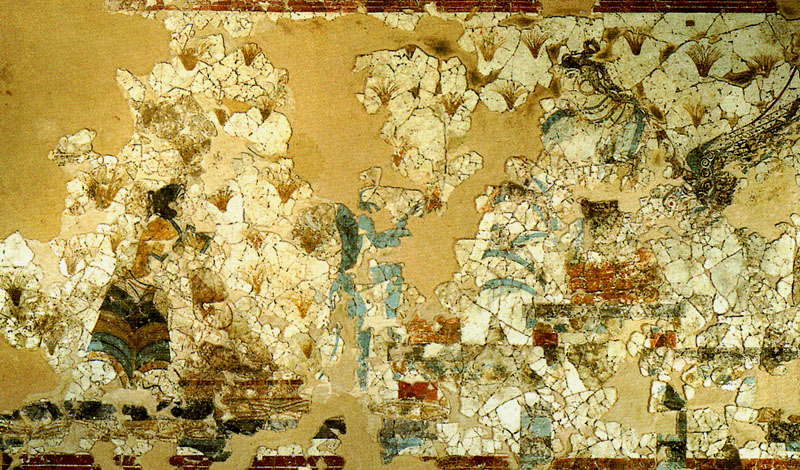
Approximately 1600BC: a volcano on the island of Thera in the Aegean sea erupted, destroying the Cycladic civilisation there. Often referred to as the “Bronze Age Pompeii,” the settlement known as Akrotiri was caught up in this cataclysmic event. Ironically, it was the anaerobic conditions caused by pumice and other volcanic debris smothering the town which preserved it for present study. Thera, one in a chain of Cycladic islands, may be just one sickle moon-shaped, seemingly insignificant land mass, but it also provides some of the best examples of Aegean Prehistoric Art.

To conceptualise ‘art’ is never a straight-forward process-in this case I’m specifically referring to wall frescoes in houses, the subject matter of which is hardly transparent in nature. Loaded with ambiguous imagery, the Theran frescoes have been the subject of protracted academic debate since they were first discovered in the 1970s. In order to avoid surfeiting on rhetoric, I will instead approach the subject of Aegean Bronze Age art through a case study of one particular Theran fresco: ‘The Mistress of the Animals.’

It is necessary first to contextualise Thera further both geographically and culturally. The island is often considered to have been linked at least to a certain extent with the Minoan civilisation on Crete, not least because their weight system, syllabic script and similar fresco artwork have been found on the island. However, it is difficult to equate Minoan civilisation, which is known mostly from ‘palatial’ excavations, with the settlement at Akrotiri, the status of which is currently undecided.

Conscious of the inevitably limited analysis and artificial nature of such a pursuit, my study of an individual fresco will hopefully elucidate some of the major themes and issues surrounding the interpretation of Aegean Bronze Age fresco artwork. Theoretically speaking, trying to understand any piece of ancient art is always fraught with issues of imposing anachronistic values onto an image, or assuming that ‘art imitates life.’ Thus, this piece will be highly speculative and should be read as such.

‘The Mistress of the Animals’ fresco, or ‘Saffron-gathering’ fresco, as it is often referred to, is located within a building known as ‘Xeste 3’ on Akrotiri. The function of the structure itself has not been conclusively determined, though there are suggestions it perhaps performed a ritual or cult function. In the eastern-most section of Xeste 3 there is a ‘lustral basin:’ a square room at a lower level to other rooms surrounding it. Arthur Evans, the original excavator of Knossos on Crete, believed these features to be indicative of purification rituals. However, Evan’s traditional theories have been called into question frequently over the last few decades, and a case in point is that the lustral basin in this building does not have a waterproof floor. The fact that no cooking pots, but small jars containing remnants of food were found in the building, is perhaps stronger evidence of communal activity in a structure which was not residentially occupied.

A short description is necessary: ‘The Mistress of the Animals’ fresco shows a female figure, seated on a platform, being offered crocus flowers by a blue monkey in front of her, and being pawed by a griffin behind her. Behind the monkey a young girl or woman holds a basket; she is involved in crocus gathering. The first, and most obvious point which can be made from the fresco is that a clear differentiation is being made between the central, seated female figure and everything else, animal or human, in the scene. Being positioned at the highest point, one would assume she is being designated as symbolically superior. Furthermore, she wears more elaborate clothes and jewellery than the other female figure in the picture. The next step is to identify her: is she a leader, a priestess, a goddess? Nanno Marinatos, the daughter of Spyridon Marinatos who originally excavated Thera, maintains: “That this figure is a goddess is a sure thing.” However, the only evidence she cites for this are the observations detailed above. The nature of leadership, as well as religious leadership, is one of the most contentious subjects in Aegean archaeology. No definitive images of leaders have yet been discovered. Though it is difficult to ascertain the reason for the seated woman’s differentiation, an exploration of possible interpretations of the three other figures in the scene may at least introduce further possible theories.

Griffins are often associated with indications of centralised power in the Bronze Age Aegean. The most well-known example of this is the fresco with two griffins flanking the ‘throne’ discovered at Knossos. As this particular fresco is much later than the one in question, no direct link can be made, but it is also true that there are numerous other representations of woman associated with griffins, including a gold finger ring from Phourni, Archanes dating to 1600-1500BC. This particular example is also concomitant to elite status-such an item will have been prestigious. Of course, the griffin is a mythological creature and its inclusion in the fresco is arguably indicative of the seated woman having a preternatural power. Speculation aside, it is also important to note that griffins can be classed as part of the corpus of Near Eastern iconography.  In Egypt, the griffin first appears in Middle Kingdom artwork, and is elaborated in the New Kingdom with a solar disc on its head. The inclusion of a griffin in this fresco highlights questions of possible Near- Eastern affinities and the possibility that the seated figure draws her power from this.

The blue monkey also has exotic connotations. Obviously monkeys are not indigenous to the Aegean, so it could be surmised that contact must have been maintained with the Near East in order for Cycladic artists to have had any conception of what they looked like-whether in a direct trade in animals or through the diffusion of Near Eastern art. The blue colour of the monkey likely suggests a highly idealised and possibly symbolically significant manifestation of this creature. Certainly, its representation is anthropomorphic.  Blue monkeys also appear in the House of the Frescoes at Knossos, which could suggest a common Aegean artistic koine of imagery.

Lastly, the other female figure needs to be considered. She is often assumed to be more juvenile than the main female figure because of her hairstyle. Scholarship on this subject has often referred to the Egyptian practise of designating age according to a partial shaving of the head: the young girl appears to only have a short pony tail and closely shorn hair. Within the context of the other frescoes in Xeste 3, this observation makes more sense. The building contains numerous frescoes of woman with various hairstyles evocative of Egyptian equivalents, either involved in crocus-gathering or other inexplicable activities. The general atmosphere of these frescoes is one of exclusively female activity (though it should be remembered there are also representations of males in the building). Did Cycladic and Minoan society reserve a special place for certain women, perhaps in a ritual context? Women, specifically young women are very prominent in the Xeste 3 frescoes, but that’s all that can be confidently asserted.

An overall synthesis of all the aspects of the “Mistress of the Animals” fresco must be attempted. Themes of Near Eastern influence, female power and the blending of the natural and preternatural world have reoccurred in this discussion. The main point I wish to make is that the fresco can be interpreted along two lines: either in terms of contrasts or a continuum.  It could be said that the pre-eminence of the enthroned woman is demonstrated through the contrast between her and all the other figures in the fresco, between woman/ goddess and animal, between woman/goddess and young girl. Marinatos’ analysis is strongly along these lines: “The goddess is symbolically separated because her animal attendants are exotic and one is fabulous.” I would disagree: the positioning of the figures could actually suggest a continuum of relations. The griffin and monkey do indeed both appear part-way up the tri-partite platform the woman sits on. The monkey acts as mediator in offering to the elite, and the griffin is able to touch her. The girl however, is completely separate. Perhaps this is the strongest evidence for the divine status of the seated woman. Yet, instead of construing status from a power over animals and beasts, it could be said that the seated figure is dependent upon these flanking creatures in order to appear superior. In his “Enquiry into Living Creatures” Aristotle spoke of a “continuum between the animal and human worlds” in which humans were the “most complete.” Of course, referencing Aristotle in relation to Bronze Age artwork is completely anachronistic, but I mention him to further conceptualise a theoretical reading of the “Mistress of the Animals” fresco. Dichotomies can be constructed from the imagery, but I wish to suggest a more inclusive perspective, whereby all the elements of the composition, whether divine, fantastical, human or animal, operate on an inter-related continuum which should not be read in terms of straight-forward hierarchies. The fresco as a whole depicts a group invested in the activity of saffron-gathering; whether mortal, human or not, they are all inter-dependent.

Bibliography

Cartledge,P. 2002.The Greeks A Portrait of Self & Others

Marinatos,N. 1984. Art and Religion in Thera Recontructing a Bronze Age Society

Marinatos, N. 2010.  Minoan Kingship and the Solar Goddess A Near Eastern Koine

The Human Machine and Contemporary Capitalism

Articles

Capitalism has always subordinated human activity to machines. In the last thirty years, however, there has been a qualitative change in the nature of this relationship. The machine has increasingly ceased to have a physical existence outside of the brains and bodies of the workers and it has, instead, become integrated into the organic structures of the working-class itself. The aim of this article is to analyse the nature and effects of this change and consider some means by which this condition can be resisted. This article engages throughout with the work of the thinkers associated with post-Operaismo, who have been active in developing ideas in this area.


Let us first consider how Marx conceptualised machines. For Marx, the machine (or fixed capital), though in one sense the technical means by which the proletariat produces surplus value, is also the congealment of the social knowledge of humanity. Machines do not spring from nature, and are rather the “organs of the human brain, created by the human hand; the power of knowledge, objectified” (Marx 1973: p. 706). In this way, knowledge, or the ‘general intellect’, can be accurately described as a direct force of production when objectified in a system of machinery. The conditions of social life therefore “come under the control of the general intellect and [are] transformed in accordance with it” (p. 706). In a similar fashion, workers operating technological apparatuses become appendages to the machine. In contrast to the tool, which the individual worker animates through his or her own skill, the machine comes to posses the strength and skill of the workers and “is itself the virtuoso, with a soul of its own in the mechanical laws acting through it…The worker’s activity, reduced to a mere abstraction of activity, is determined and regulated on all sides by the movement of the machinery, and not the opposite” (p. 693). Machines oppose the workers as an alien property, and subordinate living labour to objectified labour.


However, Marx’s conception of the machine, though providing some important analytical insights, cannot in itself explain the relationship between human activity and machines in the current, post-Fordist, stage of capitalism. Production is no longer primarily or exclusively based on physically identifiable machines, the “locomotives, railways, electric telegraphs, self-acting mules etc.” which Marx describes. Instead, knowledge, information, affect, and communication have become direct sources of productive wealth without becoming physically congealed and objectified. In this way, the human faculty of thought is put to work. Paulo Virno’s adaptation of Marx’s concept of the general intellect is important in this regard: “It seems legitimate to maintain that, according to the logic of economic development, it is necessary that a part of the general intellect not congeal as fixed capital but unfold in communicative interaction, under the guise of epistemic paradigms, dialogical performances, linguistic games” (Virno 2004: p. 65). The machines that now command live labour and make the worker produce are not to be found in physically identified objects, and are instead located within the workers themselves. It is in this way that humans can be described as becoming machinic (Marazzi 2011, Pasquinelli 2011). Capital, through the flash of the computer screen or the ring of the mobile phone, can at any moment activate the machine within the workers (i.e. their linguistic and communicative ability). The human machine, understood in this sense, is never turned off.


The absorption of the machinic into the working-class themselves necessitates a fundamental change in the way capital interacts with the organic structures of the human body. In the Fordist stage of capitalism, which was characterised by operative, repetitive and material labour, the bodies of workers were worn out through their engagement with machines. Once the body was worn out, the worker was either replaced (by a fitter worker) or repaired (through the accessible health services, which emerged with the welfare state). However, these mechanisms for the maintenance of the working-class are no longer sufficient for post-Fordist capitalism. Instead, in this stage of capitalism, a clash develops between the abilities of humans and needs of capital, leading to the rewiring, reformatting and upgrading of human brains and bodies. The nature of labour in post-Fordist capitalism, with the immersion of the worker in the hyper-stimulating information flows, reacts back on the functioning of the brain. Franco ’Bifo’ Berardi argues that it has become increasingly necessary for capital to inhibit sensibility, i.e. the ability to interpret signs which are non-verbal and which cannot be codified into binary systems. This form of communication, which deals with empathy and emotion, is dangerous to contemporary capital as it slows down the flow of information, thus undermining the productivity of the worker. By inhibiting sensibility the human machine becomes fully integrated into communicative-productive systems, resulting in the smooth and rapid production and exchange of symbols, signs and abstract codes (Berardi 2011). This new condition moves far beyond a change in what people think (in terms of ideological conditioning) and instead involves a change in how people think.


How can the condition described above be resisted? Guy Debord observed in 1957 that “the passions have been sufficiently interpreted; the point now is to discover new ones” (Debord 2006: p. 43). The hitherto existing passions have not simply been interpreted, however, but also denied. The insertion of the machine into the organic structures of humanity must therefore be resisted on an emotional level, with innovative passions being collectively cultivated. Experimental forms of behaviour and intense sensation become ways of disrupting the productive-communicative systems of capitalism. In this sense, an outburst of emotion represents the post-Fordist form of sabotage, the ‘wooden shoe’ of the new bionic working-class. Although this is a project that could conceivably be attempted in the virtual sphere, it is clear that a collective element in the corporeal sense is fundamental. The physical appropriation of space by real existing human beings provides the basis for the development of precisely those forms of behaviours and types of feeling that capital attempts to suppress (such as sensibility). Establishing collective ambiences conducive to the cathartic and emotional expulsion of the machine from the body is therefore an important aspect of resistance to contemporary capitalism.


Bibliography


  • Berardi, Franco ‘Bifo’, After the Future (Edinburgh, 2011)
  • Debord, Guy, ‘Report on the Construction of Situations’ in Ken Knabb (ed.) Situationist International Anthology  (Berkeley, 2006)
  • Marazzi, Christian, Capital and Affects, The Politics of the Language Economy (Los Angeles, 2011)
  • Marx, Karl, Grundrisse (London, 1973)
  • Pasquinelli, Matteo, ‘Machinic Capitalism and Network Surplus Value: Notes on the Political Economy of the Turing Machine’, http://matteopasquinelli.com/docs/Pasquinelli_Machinic_Capitalism.pdf (2011)
  • Virno, Paulo, A Grammar of the Multitude (Los Angeles, 2004)